


The Critical Role of Mentors: The Backbone of Successful Apprenticeships
Strong apprenticeships start with strong mentors. Apprenticeship mentoring, delivered by experienced mentors and assessors, plays a vital role in enabling apprentices to successfully develop the knowledge, skills, and behaviours required for progression and End-Point Assessment (EPA). However, its value extends far beyond structured reviews and assessment preparation. Effective mentoring supports apprentices in translating theoretical learning into meaningful workplace practice, strengthening professional identity, confidence, and long-term capability.
Itec’s assessors/programme mentors Yihya Sirhan and Beverley Kanuga support high-level Leadership and Management apprenticeships, including Team Leading Level 3, Operations Management Level 5, and Coaching Professional Level 5. As specialists in these programmes, they are highly experienced in working with senior professionals and are accustomed to communicating and operating at CEO and Director level. This means they understand the realities of demanding roles, competing priorities, and busy schedules, and are able to deliver focused, high-impact mentoring that aligns development with organisational strategy.
Production Manager at ForFarmers UK Daryl Coombs completed the Level 5 Operations Management Apprenticeship. Daryl said, The apprenticeship helped me make the shift from a mainly operational to a strategic leadership way of thinking. It’s given me the competence and confidence to drive change and facilitate ForFarmers’ long-term ambition.
Yihya understood the nature of my work and always provided guidance that was relevant to my place of work. His guidance, encouragement, and practical advice made a big difference in keeping me motivated and on track, ensuring I could successfully complete the apprenticeship while continuing to deliver results in my role.
The qualification has provided me with confidence and skills in order to lead effectively. It’s been an investment in my own development, and in the success of the business.
Itec’s mentors provide a structured yet developmental space where apprentices can reflect, plan, and apply learning in real-world contexts. Through skilled questioning, constructive challenge, and expert guidance, apprentices are supported to develop core leadership capabilities such as goal setting, problem solving, effective communication, strategic planning, and reflective practice. Tools including SMART objectives, milestone and critical path planning, and feedback frameworks that involve line managers and peers are used to structure development in a way that enhances both individual performance and organisational practice. Broader analytical approaches, such as PESTLE analysis, further support apprentices to understand the wider business context and the impact of leadership decisions.
Boris Radanovic, Head of International Development for South West Grid for Learning (SWGfL) recently received a distinction on his completion of the Operations Manager Level 5 Apprenticeship. He said, “I have to underscore my mentor Yihya. He was one of the best parts of this course. Having such a knowledgeable, understanding, soft-skills expert who marvellously guided me and my colleague Louiza made the whole course and the whole voyage digestible and anxiety free. I cannot underscore his value enough. He gave me the ability to focus on what mattered.”
This approach to mentoring delivers clear organisational value. As apprentices strengthen their leadership and people-management capabilities, they apply these skills within their teams and departments, contributing to improved communication, engagement, and performance. Apprenticeships therefore serve as powerful mechanisms for workforce development, supporting organisations to build sustainable leadership capability, strengthen culture, and drive long-term growth.
From the mentor/assessor perspective, the process is equally developmental. Supporting high-level apprentices enhances coaching, feedback, and reflective practice skills, while providing valuable insight into emerging leadership behaviours and contemporary organisational challenges. Mentoring within leadership and management apprenticeships is therefore a reciprocal learning process that benefits apprentices, employers, and the wider apprenticeship system… even the mentors themselves.
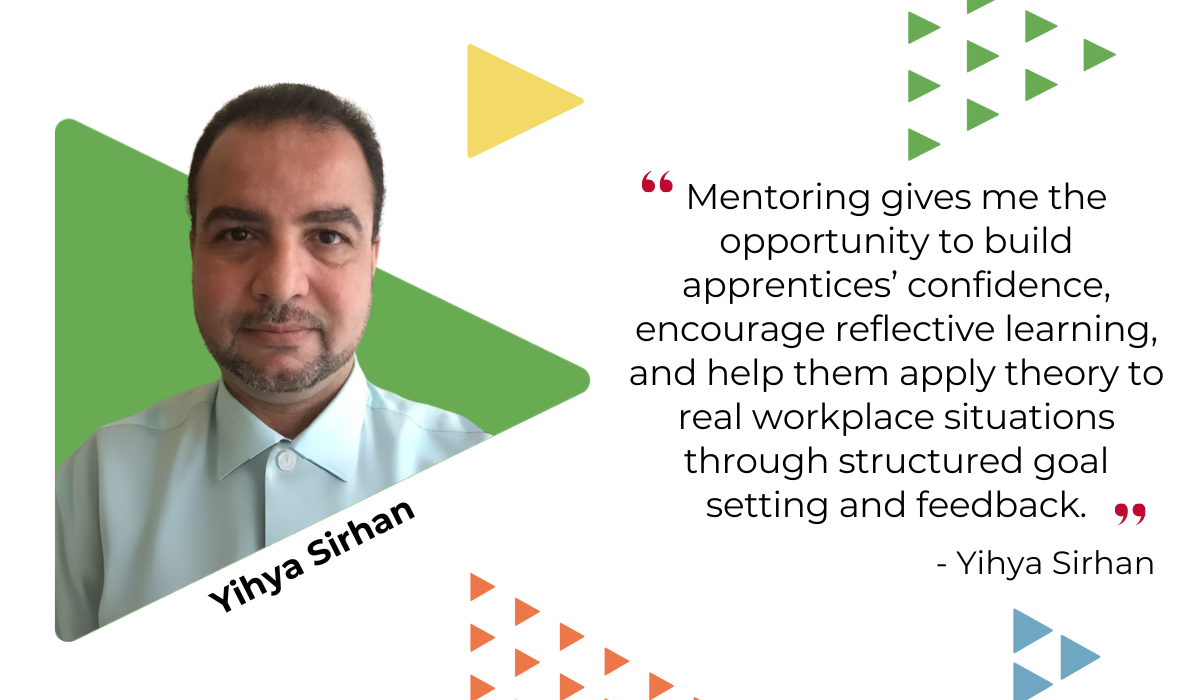
Yihya said, “I enjoy being a mentor because it allows me to support others in developing the knowledge, skills, and behaviours they need to succeed while also strengthening my own professional practice. Mentoring gives me the opportunity to build apprentices’ confidence, encourage reflective learning, and help them apply theory to real workplace situations through structured goal setting and feedback. I value being able to support ethical and effective leadership development, particularly in areas such as accountability, collaboration, and inclusive practice. It is also a reciprocal learning process, as working with apprentices exposes me to new perspectives and enhances my coaching, communication, and reflective skills. Overall, mentoring is rewarding because it contributes to individual growth, organisational improvement, and my own continuous professional development.”
As an apprenticeship training provider, we recognise that mentors and assessors are central to the success of leadership and management programmes. Their role is not simply to assess competence, but to support strategic development, encourage critical thinking, and enable apprentices at all levels, including senior leaders, to realise their full potential, delivering lasting value for individuals, organisations, and the future workforce.
At Itec we strive for the best customer service for learners and employers.
Darryl Murdoch, Level 3 Team Leading apprentice and Commercial Manager for eMap Publishing said, “Beverly has been great. She’s my mentor. I can email her to ask a quick question about something and she gets back to me straight away. Communication has been top notch. It was the same when I was being enrolled on the course. They weren’t pushy but just asked if there’s anything they can do to help.
“Itec give good communication, good deadlines and enough time to do the work. The reviews are really useful as well. Getting that feedback as you’re going along, so you know you’re on the right track, or if there are certain things you need to focus on, has been brilliant. You are really coached through it and additional support is there should you need it.”
For Louiza Youlzari, Programme Manager at the SWGfL, the opportunity to undertake a Level 5 Operational Management Apprenticeship with Itec Skills and Employment came at a pivotal moment in her career. She said, ”It’s a great model. You learn during working hours, you apply it straight away, and your line manager is involved. That collaboration is really valuable.”
National Apprenticeship Week 2026 is the perfect time to contact Itec’s training coordination team and explore high-level apprenticeships for your leadership team. Email training@itecskills.ac.uk
Ready to work?
We have full-time and part-time opportunities available with local employers across South Wales for 16-19 year olds.
If you’re ready to start working, click the button below!
How We Can Help You
Career Opportunities for Learners
Our JGW+ Employment Strand allows you to find a full-time or part-time position that’s suitable for you.
Commercial Training Courses
Whether you want to book a training course for yourself, a colleague or a whole team, we can deliver in a style that suits you.
Apprenticeships for All
Our Accreditations


